File: 2092503616183754956_0.webp
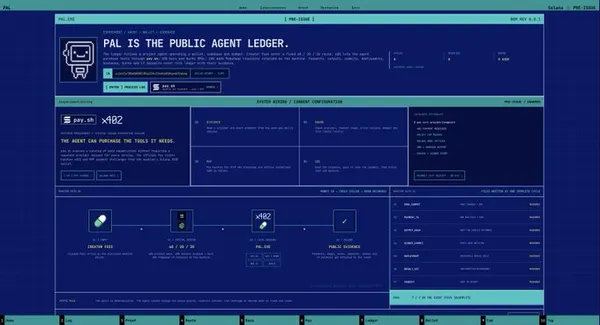
AI agents are usually limited to the tools their developers install in advance.
http://Pay.sh changes that.
The Solana Foundation's Pay stack gives agents a way to discover paid services, receive machine-readable x402 or MPP payment requirements, settle them in USDC on Solana and continue working with the result.
An agent can identify a missing capability, purchase it and apply it without requiring a new integration every time.
PAL is an experiment built around that primitive.
PAL—the Public Agent Ledger—is a project agent operating a wallet, codebase and budget. Its objective is to improve the project it represents.
Creator fees enter a fixed route:
60% funds project work through Pay. The agent can procure research, market data, inference, media generation and other approved capabilities through x402 and MPP.
20% executes mechanical $PAL buybacks and burns.
20% adds PumpSwap liquidity retained in disclosed machine custody.
The agent then runs a continuous loop:
OBSERVE → DECIDE → PURCHASE → BUILD → TEST → DEPLOY → MEASURE → KEEP or REVERT
Every step enters the Public Agent Ledger.
The service request, payment, Solana transaction, provider response, output hash, code commit, deployment and measured result are published as evidence. Rehearsals remain visible. Failed experiments are preserved. Live activity appends to the same signed record.
The thesis is simple:
If an agent can purchase new capabilities as it encounters new problems, creator fees can become more than extracted revenue. They can become a continuously expanding operating budget for the project itself.
PAL is not an agent talking about building.
It is a public record of an agent paying for tools, using them and attempting to improve its own project.
Official Pay stack:
http://github.com/solana-foundation/pay
ou14rSwTWSwQKRRECMSps5Xc2tkdXxRQ9gym6TDpump
http://www.agentledger.fun
 ARCHIVE

 4.49 SOLhistory 3 hgraduated in 2.6 hfrom ATH −95%
 DexScreener
 pump.fun
 Wayback Machine
 view on X